

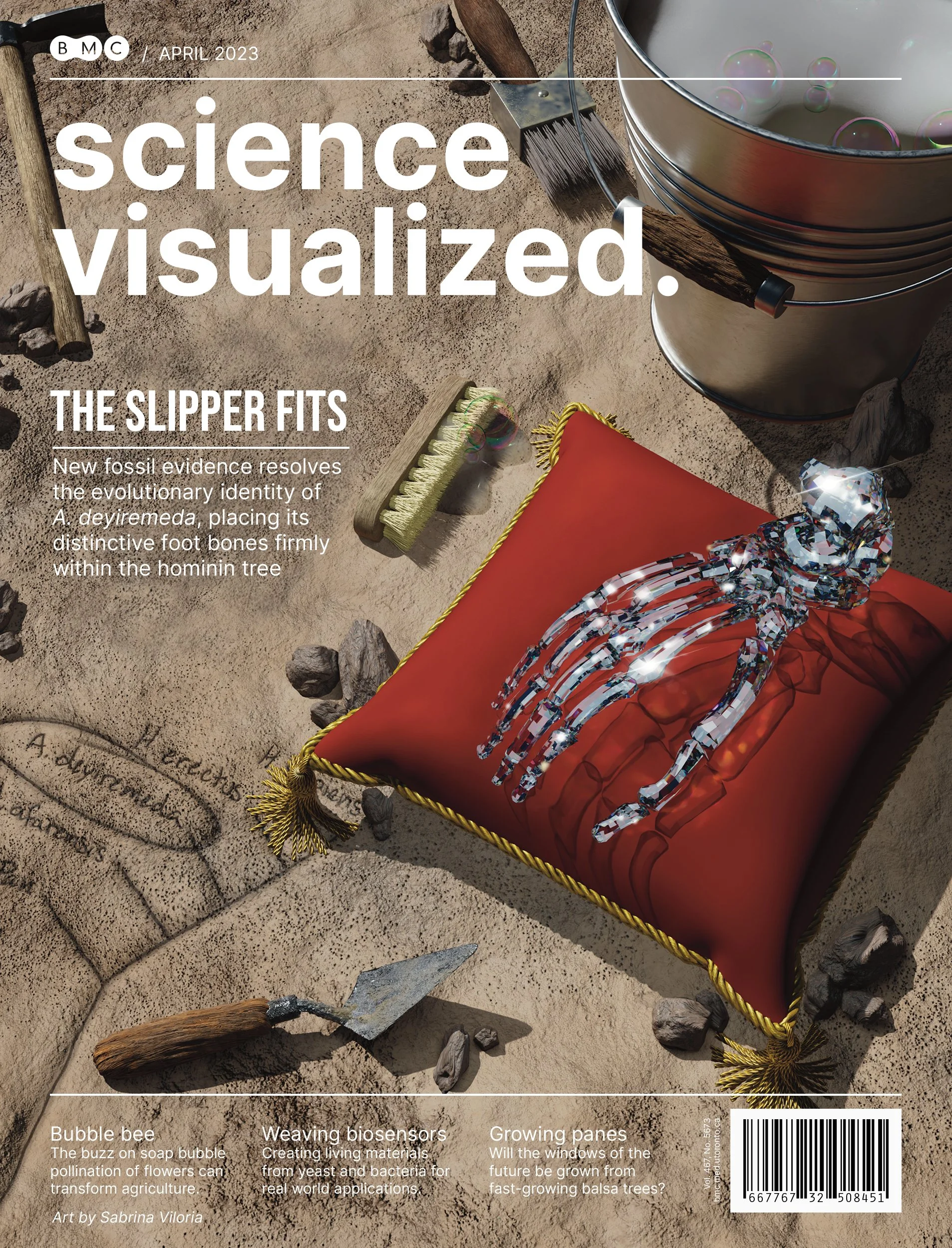
Editorial cover
The slipper fits
Inspired by a recent study on the identification of Australopithecus deyiremeda foot remains, this 3D editorial cover reimagines a paleo-anthropological discovery through the visual metaphor of the Cinderella story. Glass foot bones, sitting on a velvet pillow like a slipper, symbolize the long-awaited identification of their evolutionary “owner” after years of uncertainty. Set within an archaeological excavation, the scene integrates etched phylogenetic imagery and excavation tools to bridge fairytale symbolism with scientific evidence.
Research
This cover is based on recent paleo-anthropological research investigating the identity of mysterious fossil foot remains discovered in Ethiopia, and ultimately attributed to the hominin species Australopithecus deyiremeda. For years, the partial foot bones remained taxonomically unresolved since researchers lacked sufficient anatomical evidence to confidently assign it to a species. Newly recovered dental and skeletal fossils allowed scientists to link the distinctive foot bones to A. deyiremeda, clarifying aspects of its locomotion, diet, and evolutionary relationships while rewriting history as it relates to early human ancestors.
I was inspired to create this illustration from the narrative quality of the discovery. Like Cinderella’s glass slipper, the fossil foot functioned as a long-unidentified object, whose true owner was searched-for, and finally identified.
Layout ideation and comprehensive sketch
My initial concept sketch featured the glass foot bones sitting on a pillow against a line-up of hominin species waiting to ‘try it on’. However, after developing the metaphor and composition further, the idea did not translate as seamlessly as in concept.
After looking at more reference imagery and creating more sketches that communicated the archaeological nature of this story, I decided to construct a scene that revealed glass A. deyiremeda foot bones on a pristine, royal red velvet pillow with gold trim and tassles sitting in an archaeological site. The juxtaposition of the regal and precious diamond-like find against a weathered background surrounded by dirty tools made for a fun and exciting scene.
After creating the scene in a comprehensive sketch, I decided to add a phylogenetic map etched into the ground of the scene, as though excavators had finally ‘worked out’ the mystery owner of these enigmatic bones. This made for a well-rounded scene, which meant I was ready to begin modelling these elements in Autodesk Maya.
Modelling and texturing
I first created a mock-up of where my elements would fit and how they would be staged on camera to reflect my sketch. From then, I modelled each element individually and textured each one on Adobe Substance painter to achieve the weathered look I was aiming for. To create the glass and diamond-like effect of the foot bones, I modelled them as low-poly shapes that created a sparking, eye-catching centerpiece.
Rendering and style
In the rendering stage, I primarily focused on ensuring I had the best lighting to communicate that the scene is indeed occurring outside and is the product of a long day excavating and searching.