

Flow of urine
Infographic
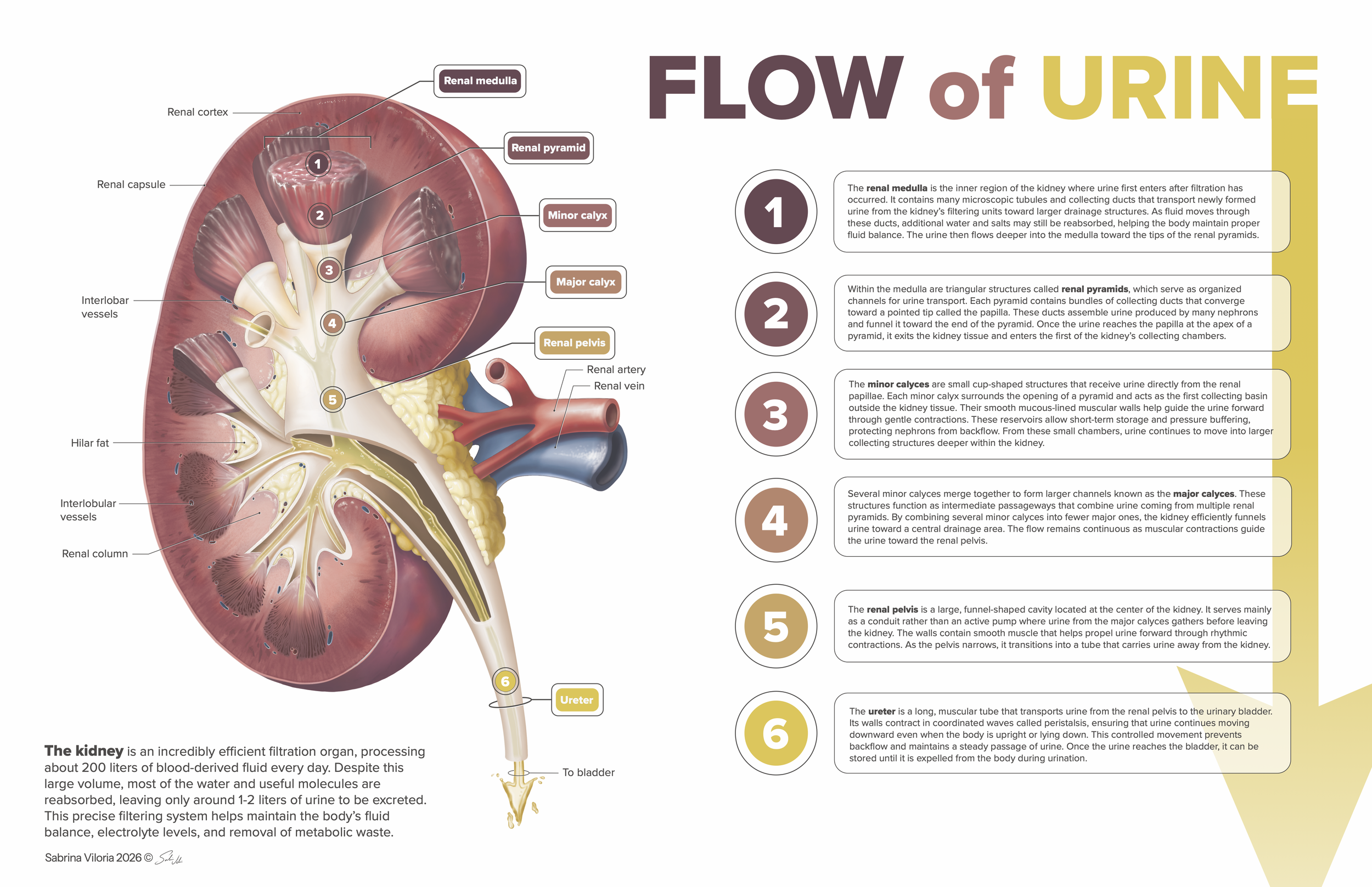
This piece showcases an accurate and realistically illuminated human kidney in a unique cross-sectional view with a cutaway portion within, allowing for the appreciation of internal structures of the kidney and how urine passes through it. A comprehensive six-step infographic explains in detail how this concentrated waste product is efficiently removed from the body through the specialized structures of the kidney. The use of a downward arrow is illustrated on the kidney itself and featured again on a larger scale on the right to complement the didactic colour-coded structural explanation of this process, drawing the eye from top to bottom and creating visual unity and interest.
Research
To conduct the necessary research to represent this organ accurately, I consulted textbooks, peer-reviewed articles, papers, and surgical videos to understand kidney anatomy, the steps by which urine is produced in the kidney, and to develop an accurate maquette as a structural reference. Having had the advantage of dissecting kidneys from real cadaveric donors in the months before, I had become familiar with the structure, texture, and variety to be found in the human kidney. Most of the kidneys that I examined varied in size, colour, shape, vascular attachment, and pyramidal arrangement. My research allowed me to come to a similar conclusion as I found that the human kidney has several different presentations in almost every possible aspect and feature.
In order to inform my maquette building, I consulted anatomical textbooks and photographic references of the kidney to reach an average, healthy presentation. To ensure accuracy, I looked to find CT-scan data from 3DSlicer to use as a base for a digital, three-dimensional model of the kidney to base my illustration from. Making a model had the advantage of providing me with a way to view how light behaves on the surface and shape of the kidney with a selective and interesting cutaway view.
Comprehensive sketch
Initial layout was done on Procreate by tracing over the maquette and making accurate stylistic changes such as adding depth to the ureter cut and adding in minor calyces and organic pyramids using several photographic and anatomical illustrations. I also made some changes to the cut on the ureter to make it more three dimensional and show the hollowness of the inside as this is where urine is transported to the bladder, which is the focus of the illustration.
I found very helpful atlases that depicted many views and representations of the kidney. These resources also allowed me to see how the pyramids interact with the minor calyces in a cross sectional view, how the fat is organized in the hilum, and how the renal capsule envelops the outer cortex of the kidney. Along with photographic references of kidneys, I was able to produce my first draft.
Tonal rendering and colour palette ideation
I began this process by creating discrete shapes of the different elements of the kidney to create an organized vector-like workflow from which I could discretely build tone on individual sections without impacting others. While rendering tone, I frequently consulted the literature in all manners of texture, shape, and form to achieve maximum accuracy. I came across a book on kidneys that was illustrated by Max Brodel. This book allowed me to see the location and difference between interlobar and interlobular vessels that surround the pyramids and minor calyces of the kidney. I made these changes to my illustration after finding this information.
Upon further research while rendering, I found that renal vessels around the hilar fat of the kidney tend to gather around the ureter and cortex and rarely travel through the middle of the fat. I made both of these changes to the following drafts of my illustration.
Using references from real kidney photographs, I rendered the glossy, wet texture of the kidney. When deciding how to render the urine arrow, I decided to remain as true to the goal as possible and render them as real urine passing through the regions of the kidney. Using references from the web on creating the effect of liquid following discrete shapes, I created the illusion.
Layout and further developments
In the layout stage, I added labels for the structures in Adobe Illustrator and cross-referenced them with Grant’s Atlas to confirm their accuracy. I created the comprehensive infographic using the kidney illustration to derive more educational context and use from the piece.