

Journey to the sea
Infographic
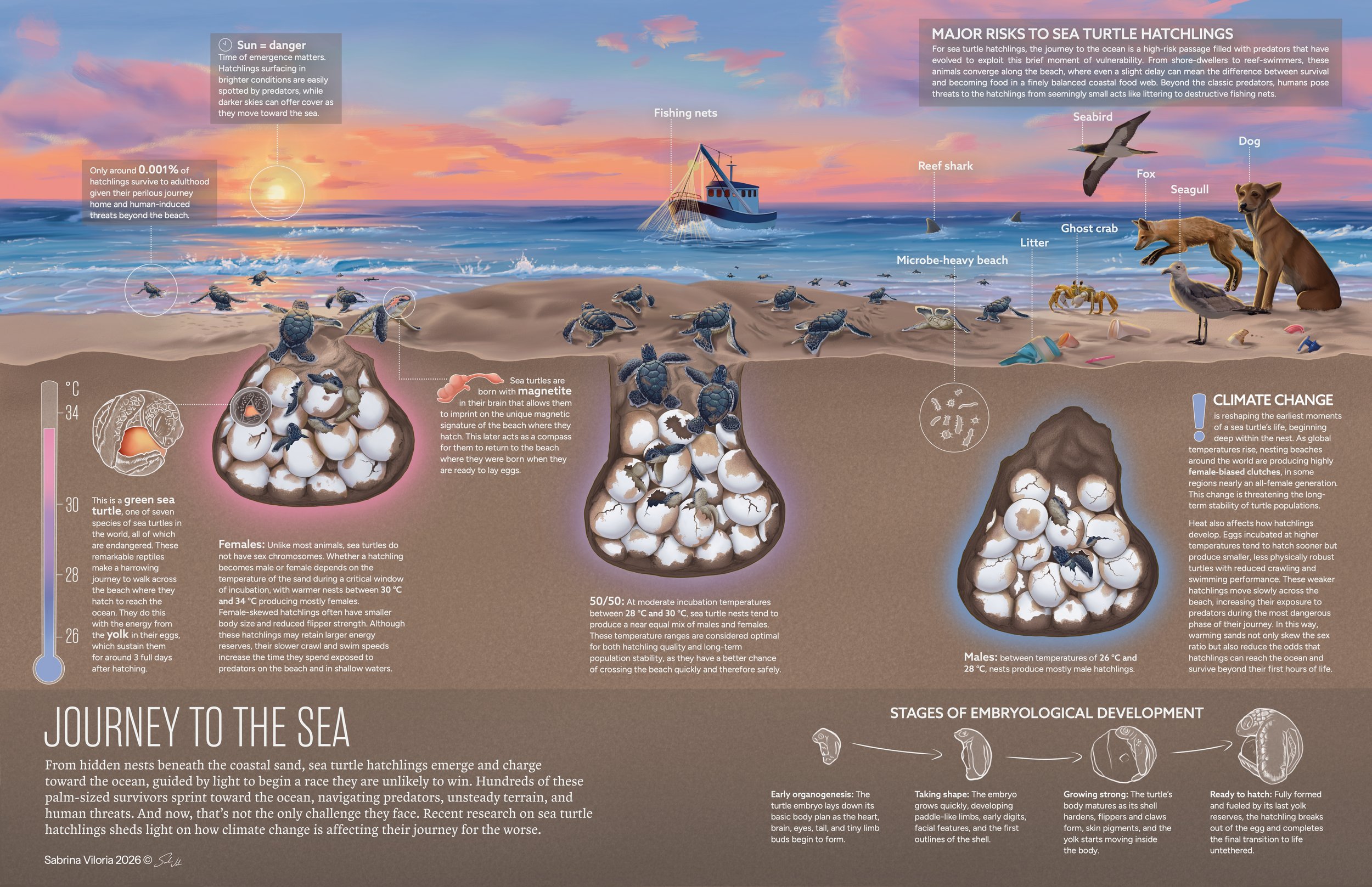
This infographic explores the remarkable and perilous journey sea turtle hatchlings take from nest to ocean, highlighting the biological adaptations and environmental challenges that shape their earliest moments of life. Although sea turtles are often seen as symbols of resilience, fewer than one in a thousand hatchlings survive to adulthood, facing threats from predators, habitat disruption, pollution, and climate change. Through extensive research, I developed a visual narrative that brings together hatchling behaviour, magnetic navigation, sex determination, predator interactions, and conservation concerns into a single immersive environment. My goal was to translate complex ecological and physiological concepts into an engaging educational piece that sparks curiosity and encourages deeper appreciation for sea turtle conservation.
Research
My background in biology (particularly animal biology and physiology) sparked my interest for depicting this topic. I had a base understanding of the sex determination and predator interactions that correspond to these reptiles. This made research more about confirmation of the newest scientific findings and filling in the gaps of this process to create a cohesive and compelling story.
Much of my initial preparation for this project began with research consisting of video documentary analyses and reading peer–reviewed articles about turtle hatchlings and the process by which they reach the ocean. From my findings, I narrowed my story to seven main topics surrounding sea turtle hatching events.
Layout ideation and comprehensive sketch
From the visual references of sea turtle hatching events and the research I collected, a rough image of the infographic came to my mind that consisted of biological information about turtle hatchlings and the odds they overcome to reach their home, the ocean.
Stemming from my research and visual references, I constructed my initial ideas regarding layout and content to include. I chose to create a scene that included story and a sequential reading order with different pockets of information featured as graphics.
To create a consistent bottom-to-top reading flow, I incorporated the title and embryological information at the base of the scene, telling the story from embryo, to hatchling, to the ocean, and all the challenges along the way.
Colour palette ideation and rendering
I began the rendering proces by laying down tone and creating the basic elements of my scene. My goal was to establish depth for the sandy cross section and discrete shapes to represent the eggs underground and call attention to this, the first line of reading for this graphic.
I also started to lay down basic colours and styles in which to render the sky of this scene. My goal for this section was to make the colours of the sky play off of the eventual colours under the sand and to create visual unity.
I experimented with the colours of the sunset to use temperature coding under the nests to showcase how warm sands create female turtles while cooler sands create male turtles, and the in between temperatures create an even mixture. The colours repeated throughout the scene call out to the main takeaways of the scene: sex determination, climate change risk, and sunset hatching dangers.
Layout and style
In the layout stage, I primarily used the information and composition established in the comprehensive with some minor modifications to optimize readability.